The following article by Russian Ambassador to Ireland Yuriy Filatov was submitted to Unity, weekly paper of the Irish Communist Party, for May 2025. Unfortunately because of the severe illness of the manager of the Unity email account the article was not found in time to publish it for the anniversary. However due to the historic importance of the topic and in remembrance of those who fought and those who died fighting fascism we are publishing it now.
THE topic of remembrance in the post-war era remains acute as we witness multiplying attempts to revise the history of World War II and a troubling resurgence of revanchist Nazi and neo-Nazi ideologies across Europe and North America. This revival, coupled with a surge in russophobia (hatred towards Russians), reminds us that the fight is not over, and the lessons of history have not been learned properly.
ON May 9, 2025 the world will mark the 80th Anniversary of one of the pivotal moments in world history — the Great Victory over Nazi Germany in World War II. The international community commemorated this milestone by unanimously adopting on March 4, 2025 UN General Assembly’s resolution 79/272, which honors the sacrifices made by all those who fought against Nazism, encourages a commitment to prevent future conflicts of such destructive nature, promotes peace and reconciliation across nations. The resolution stipulates that special solemn meeting of the General Assembly will be held this May and every five years thereafter.
For Russia and the people of the former USSR the 9 of May has a special significance, marking the end of the Great Patriotic War of 1941-1945 – the most cruel and bloodiest of all wars the country ever fought, making Victory a truly existential accomplishment forever embedded in the generational memory. Defeating the evil of Nazism was not just a military matter, it was the issue of survival. In his conversation with Deputy Prime Minister and Foreign Minister of Romania Mihai Antonescu in Berlin on November 27, 1941, Hitler openly declared his plan to eradicate Slavic ethnicities: “Only two races must remain in Europe in the future, Latin and German, they must work together in Russia to eradicate the Slavs”, adding that the Slavic problem was “biological rather than ideological”. Based on all these facts Russia’s legal authorities clearly qualify the horrendous acts committed by Nazis and their accomplices as crimes against humanity and the genocide of national and ethnic groups that represented the people of the Soviet Union.
Hitlers’s war machine was crushed by the Soviet Union at the Eastern Front, the main theatre of World War II. Historical evidence leaves no doubt that it was the Red Army who bore the brunt of the fight, engaging the majority of Hitler’s forces. The sheer scale of the Eastern Front was staggering – Nazi Germany concentrated there more than 70% of its military strength and suffered 80% of its total military losses.
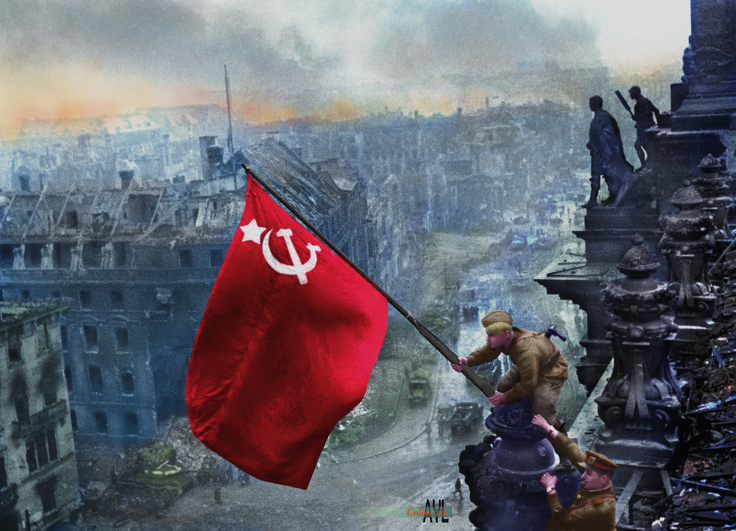
The biggest battles of the World War II took place in the territory of the USSR. They are well known, and include the deadliest ever Battle of Stalingrad (1942-1943), where Soviet forces encircled and destroyed the 6th Army of the Wehrmacht; the Battle of Kursk (1943), the largest tank battle in history; the Siege of Leningrad – a blockade which lasted 872 days and in which over a million of civilians perished; Operation “Bagration”, a Soviet counter-offensive that annihilated Hitler’s Army Group “Center” and liberated Belarus. Having broken the backbone of the Wehrmacht and flushed the enemy out of its own territory the Red Army went on to liberate many European cities from Nazi occupation, including Bucharest (August 1944), Sofia (September 1944), Belgrade (October 1944), Warsaw (January 1945), Budapest (February 1945), Prague (May 1945), Vienna (April 1945). The defining moment in the defeat of Nazism came when the Red Army marched on Berlin and captured the German capital on May 2, 1945 forcing the Nazis to surrender unconditionally. At 22:43 local time on May 8, 1945 (which was already May 9 for Moscow) the Act of Capitulation was signed by the commandment of the remaining German armed forces.
Everyone in the former USSR knows that this Victory was achieved at an extraordinary human cost of lives of more than 27 million of Soviet citizens and soldiers. According to the Russian Prosecutor General’s Office, during the occupation of Soviet territory between July 1941 and August 1944, the Nazi invaders and their accomplices deliberately exterminated more than 7.3 million people, including more than 18 thousand children, through executions and using an extensive network of concentration and labour camps. Almost 2 million Soviet citizens were kidnapped into Nazi slavery. Based on the overall statistics, the tragic occupation affected the lives of almost 80 million civilians in the Soviet Union.
The role of the USSR in the war effort was decisive and immense not only in terms of military power and human losses but also in terms of the sheer perseverance of the civilian population. Despite enduring unimaginable hardships, men, women and some teenagers worked tirelessly in factories, providing the necessary war materials, while soldiers fought with unparalleled determination to protect their homeland and bring peace to Europe.
Equally true is that the Soviet Union was not alone in its fight against Hitler’s Germany. We will never forget contribution of the United States, Great Britain and other Allies of the Anti-Hitler coalition to the joint struggle against the vicious enemy. We honour bravery and sacrifice of the Allied brothers in arms, as well as material assistance to the USSR, which included the Western Lend-Lease aid to the Soviet Union (food, trucks, raw materials etc). We will never forget great deeds by the Irish soldiers who fought as volunteers against Nazis in the ranks of the British troops, as well as brave Irish sailors who participated in the Arctic convoys, a series of naval operations to deliver vital supplies from the UK to the USSR. We remember and praise members of anti-fascist resistance movements operating all over German-occupied Europe.
At the same time, there is also another side of the story of the World War II, perhaps, not quite comfortable to some Europeans. The truth is that the USSR had to oppose not only German troops, their Italian and Romanian allies, but also one million foreign Nazi collaborators from more than 17 countries of Europe. Among the most notorious Nazi foreign legions were Spanish “Blue Division”, Scandinavian “Vikings” and “Nordland”, Belgian “Walloons” and “Vlaams Legioen”, Dutch “Nederland”, Croatian “Prinz Eugen” and many more, that were active at the Soviet-German front.
Regrettably, the shadow of Nazism did not vanish from Europe with the end of the war in 1945. Even as the world recovered from the ravages of war, the ideals of supremacy of one nation over others, militarism, and xenophobia continued to haunt certain parts of Europe and North America. In particular, Nazi ideology found a home in fringe groups and movements that often sought to glorify Hitler’s legacy, sometimes under the guise of nationalism or concepts of “ethnic purity”. This revival of extremist ideas, while initially marginalized, would find fertile ground for growth in the late 20th and early 21st centuries. After the collapse of the Soviet Union the resurgence of Nazi ideas has manifested in numerous ways, especially in Ukraine, Estonia, Latvia, Lithuania, the Czech Republic, Canada, and some other Western countries. In Kiev and capitals of Baltic States collaborationists who supported the Nazis were declared “fighters for the independence”. A number of educational and public activities have been developed and implemented to glorify those who fought for the Nazi Germany and were involved in numerous massacres of civilians.
Perhaps, the most notorious case in question is the new political regime in Kiev dominated by ultranationalist extremists and outright neo-Nazis, which openly praises Hitler’s henchman, leader of Ukrainian nationalists Stepan Bandera and members of Ukrainian punitive battalions “Nachtigall”, “Roland”, “Ukrainian Legion”, SS division “Galicia”, “Brandenburg”. Across the country we see streets named after Bandera and his accomplice Shukhevych, as well as monuments erected in their memory. At the same time Baltic States officially hold annual marches of Waffen-SS veterans. We see unpunished neo-Nazi gatherings in many other European countries, even in Germany.
One of the most troubling aspects of contemporary far-right and neo-Nazi ideologies, particularly in Europe, is the increasing spread of Russo-phobia. A close look at the social and political dynamics in the post-war Europe right up to the modern times gives reason to argue that this phenomenon has not been inherent to the Western societies. It is rather a political tool developed in recent times by the elites in an attempt to create a new “iron curtain” to isolate and contain Russia, discredit Russia’s traditional way of life and humanistic values, which are increasingly popular in the world and challenge their power.
This concept has been the nucleus of the Western project of turning Ukraine into “Anti-Russia” and provoking military conflict on the Russian borders, promoted by the vast majority of EU political leaders and mainstream media. Essential element of this design has been to distort history and falsify the USSR role in ensuring Victory over Nazism and creating a present-day system of international relations. Ideological landscape in Europe has become infiltrated with cynicism, historical revisionism and revanchism that reached a new peak and aim at whitewashing the authors of racial purity ideologies who unleashed the World War II. Downplaying or rewriting the Soviet Union’s role in the defeat of Hitler, expressing support for Nazism in many cases turned out to be a test of the loyalty of a particular state to the Western political elite. Such distortions serve to justify current political agendas, geared to sow division and animosity toward Russians. Here again the Ukrainian authorities have been at the forefront – long before the start of Russia’s special military operation they launched campaign to oppress Russian-speaking population, Russian Orthodox church, and political parties, who promoted friendly and mutually beneficial or even neutral relations with Moscow.
There is yet another important historical lesson from the pre-war Europe of the 1930s, which has been largely ignored by the West. The provocative political manoeuvring of the US, its NATO and EU allies around Ukraine bears striking resemblance to the way UK and France dealt with the Hitler’s rising aggressiveness in an attempt to channel it to the East. Back then London and Paris evaded negotiations with Moscow on the European collective security agreement hoping to push Nazi Germany to attack USSR. The history almost repeated itself when US and NATO rejected in December 2021 Russia’s proposal of mutual security guaranties for Ukraine and Russia designed to settle Ukrainian crisis by political means while the EU member states, including Ireland, refused to reconfirm their commitments made in OSCE to the principle of indivisibility of security in Europe. Had it been seriously considered it would have certainly made any military operation in Ukraine inexpedient. Nevertheless, the Western powers opted to escalate conflict in Ukraine as a battering ram against Russia in their new “Drang nach Osten”. The enormous, overriding significance of the Victory of 1945 is that it provided future generations with invaluable lessons on how to prevent war and achieve peace. These lessons have been written by the sacrifice of millions of people and cannot be erased.
The 80th anniversary of Victory is not just a commemoration; it is a call for action to stand up to the resurgence of Nazism, to preserve the hard-won peace and protect all of us from the destructive forces that once threatened to engulf the world.
important historic and present day–critical analysis