
The following article by Eoin Ó Murchú was first published in Unity, the weekly paper of the Irish Communist Party.
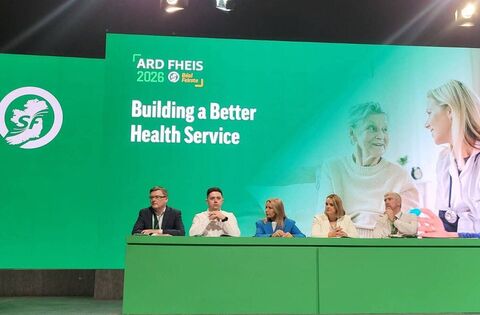
The Sinn Féin Ard Fheis, which took place in the ICC in Belfast on the weekend of 24 and 25 April last (the 110th anniversary of the Easter Rising of 1916) was a quiet affair. Despite the party being the leader North and South there is an air that it is stuck waiting for events to unfold rather than seeking new ways to advance their agenda.
The tone of the debates, and the motions passed, by and large reflected the centrist direction that the party leadership has embarked on, especially since the ascension of Mary Lou McDonald to the role of party leader.
SF is still a left of centre party with most of the classical positions of social-democratic parties. But the direction in comparison to the positions of previous years, however, is unmistakable. Like many left parties in Europe, they have embraced a large part of the liberal woke agenda, prioritising transgender activism over traditional class struggle.
That said, the vast majority of the motions proposed and passed, including the accompanied speeches by the delegates speaking on them, reflect the broadly progressive politics of Sinn Féin on socio-economic and social questions.
And the party has moved from being an activist party to being a parliamentary one. And in this regard there are many areas of party policy that are now found wanting, particularly on many core policies the party once traditionally held.
These would include their positions on anti-imperialism such as the Ukraine War, the European Union and its project of supranational integration as well as its self-definition as socialist.
The one unshakably solid core position of Sinn Féin is Irish Unity and it is genuinely committed to this objective. Now that they are Ireland’s largest political party, on both sides of the border, they are in a good position to put the issue of Irish Unity centre stage on the political agenda.
The party are making a serious effort to build a broad front for this campaign and are centrally involved in the Ireland’s Future movement, a movement consisting of a broad range of people on the political spectrum, from left to right and from green to orange.
Aside from Sinn Féin’s solid core position on Irish Unity, many previously-held core positions have been watered down. At one time, the party opposed further European Integration and the European Project itself. Over time, from the mid-2000s onwards, the party has adopted an official policy of “critical engagement” regarding the EU.
The party’s TD Eoin Ó Broin boasts of having initiated this position. This position of “critical engagement” has amounted in practice to a volte face of their previous stance of being opposed to the European Union.
Previously, they opposed the referendum to join the EEC (as it was called then) in 1972 and other referendums in 1987 (Single European Act), 1992 (Maastricht Treaty), 1998 (Amsterdam Treaty), 2001 (Nice Treaty), 2002 (Nice Treaty rerun), 2008 (Lisbon Treaty), 2009 (Lisbon Treaty rerun) and 2012 (European Fiscal Compact or Austerity Treaty).
However, during the UK Brexit Referendum in 2016, Sinn Féin called and campaigned for a Remain position, the first time that the party aligned itself with a pro-EU position. “Critical engagement” has effectively amounted to engagement with the EU, but with minimal criticism of its integrationist objective.
While Sinn Féin’s stance on the Ukraine War has become more muted in the last two years, Mary Lou MacDonald referred to “Putin’s criminal invasion of Ukraine” in her keynote leader’s speech. Donnchadh Ó Laoghaire also condemned Russia and reiterated the party’s commitment “to stand with Ukraine”, the only two times that Ukraine War was mentioned in passing reference during the Ard Fheis.
This is quite a change since the febrile early months of 2022, when Sinn Féin feverishly lined up behind the Establishment position as dictated by the US, the EU and NATO.
Notwithstanding Sinn Féin’s position on Ukraine, the party did condemn the illegal kidnapping of Venezuela’s President Maduro, the US/Israel attack against Iran and the looming US threat against Cuba.
Much of the moderation of Sinn Féin’s politics can be traced back to the 2001 Ard Fheis where all references to socialism, except one article, were deleted from the Sinn Féin Constitution and replaced with “social and economic justice”, requiring and securing the necessary two thirds of delegates to do so.