The following article by Eoin Ó Murchú was first published in Unity, the weekly paper of the Irish Communist Party.
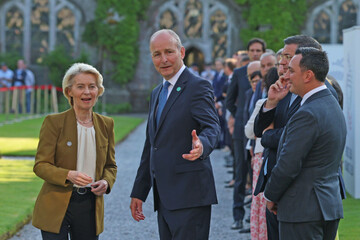
The surreal spectacle of pomp and pageantry that has accompanied the official launch of Ireland's six-month tenure of the European Union Presidency must rank as one of the most grotesque exhibitions of servility and subservience that Ireland has ever endured.
Of course, no other European state begins its six-month presidency with such a display, but Taoiseach Micheál Martin is perpetually eager to show that Ireland is the teacher's pet and to reassure our European masters that they should look favourably upon us.
Even more absurd, of course, was the presence of that perennial beggar, Zelensky of Ukraine – who is not even an EU member – yet was given pride of place from which he lectured us on the moral imperative to close the factory in Aughinish, a factory that provides decent employment for a thousand Irish workers in a part of the country that is desperately in need of jobs.
The mainstream Irish media were no better, covering the event in a sycophantic and fawning manner, wheeling out the same experts to prattle on senselessly about the Presidency's agenda, while avoiding any truthful discussion of the real problems actually facing the European Union.
For instance, the EU currently faces two major issues: energy costs and a lack of competitiveness on global markets, particularly regarding China.
Peace is essential – in Ukraine and in the Strait of Hormuz – if there is to be any chance of reducing energy costs. Micheál Martin has no intention of allowing any debate on such matters, even though we are a neutral state – officially, if in no other way.
As for competitiveness, it is easy to talk about taking a strong stance against China. But there are clear problems with that. First, European manufacturing can barely function without the supply chains that come from China; and second, China has a greater capacity for retaliatory countermeasures.
The sad point they all ignore is that Europe's capitalism is going down: it's a beaten docket.
However, it is disagreement over the EU budget that will cause the most friction. Again, this has not been examined at all.
There is a proposal from Sweden to reduce the European Commission's proposed Multiannual Financial Framework (MFF) for the period 2028 to 2034 by 20% – from €2 trillion in total to €1.6 trillion. Several northern member states support this, including Germany, Austria, the Netherlands, and other Nordic countries.
The Cypriot presidency did not resolve this. (Yes they held the EU presidency before us). And an Irish EU presidency has only one chance. The decision must be made by unanimity – so it is irrelevant that the number of net recipients from EU funds is greater than the number of net contributors.
If the northern group's position were to prevail, the most threatened area would be the Commission's proposed €589.6 billion programme for competitiveness, prosperity, and security, which includes €175 billion for Horizon Europe and €131 billion for defence and space.
Cuts could also be made to the proposed €215.2 billion external action instrument for neighbourhood policies. But there will be no cuts to the money given to Ukraine. This money is ring-fenced, so there is no escaping the hook of the never-to-be-repaid loan that the EU is giving to Ukraine, and for which Irish taxpayers will have to divert money from social welfare to repay.
So whichever way it turns, the EU and its much-vaunted global capitalism can find no way out of the crisis in which it is now stuck,
Where does Ireland stand? We do not know, because it is not being discussed.
And what kind of Europe do we want? After all, when we joined in 1972, we joined an economic and trade cooperation unit. Do we now want a Europe that imposes mandatory rules beyond those economic parameters?
Do we want a Europe that respects national sovereignty, and is committed to diplomacy and the pursuit of peace, or are we wholly behind the militarisation of Europe and a common foreign policy with the former imperial powers?
God forbid that the Irish people should be informed that real debates on these issues are taking place in other EU states, but not in Ireland, where we remain humbly obedient to the Commission to tell us what to do and what to think.