
The following article by Jenny Farrell was first published in Unity, the weekly paper of the Irish Communist Party.
IF you're considering visiting Russia, let's cut through the Western media noise: travel is genuinely recommended. It's rewarding, eye-opening and surprisingly easy, with one genuine headache: Western bank cards. We obtained our visa online in under five days and booked flights and hotels with Western cards. Inside Russia, however, Visa and MasterCard no longer work because of sanctions. Russians use UnionPay cards for international travel, while visitors can easily exchange cash for rubles.
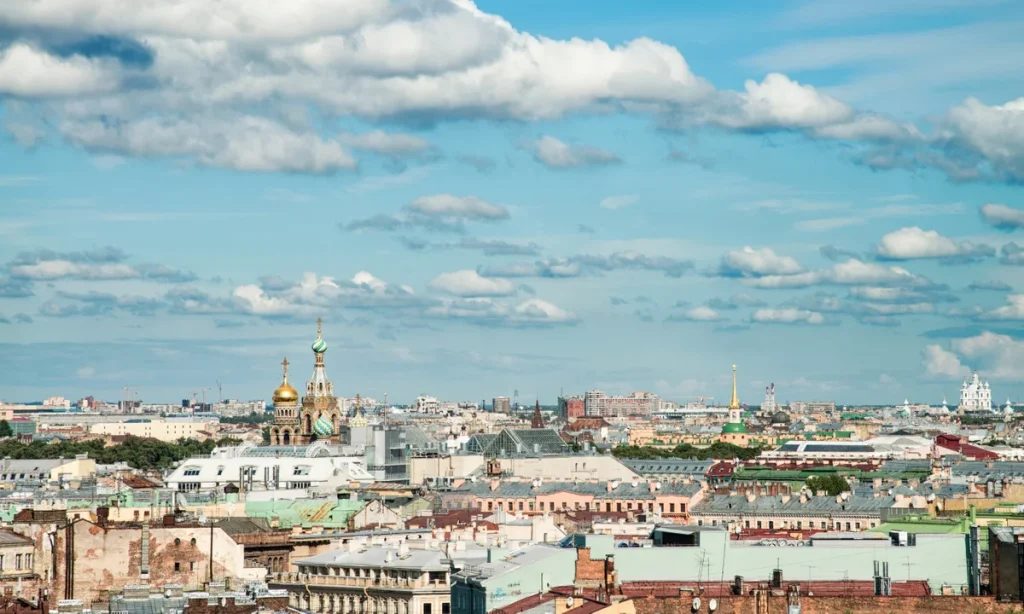
We met our old friend Ilya Klemyonov of the Communists of Russia party at their new premises in Leningrad, ironically next door to an Irish pub. While the comrades enjoyed their customary "sto gram" (100 ml of vodka), we discussed politics with Ilya and General Secretary Sergey Malinkovich. Asked about drone attacks, both reflected the city's calm attitude. As Sergey noted, the Siege of Leningrad remains central to the city's identity, making modern drone attacks seem minor.
Sergey showed us a photograph of his grandmother, a machine-gunner who defended the city against Nazi aircraft. Many people proudly shared family stories of relatives who survived or died during the 900-day siege. That memory remains vivid. The wartime slogan "This is our cause" now appears on billboards in connection with the conflict in Ukraine. According to Ilya, public support has rallied around Putin, with many viewing the war as a confrontation with the West and a continuation of the Great Patriotic War. Since the West appears unwilling to negotiate, many believe a wider conflict is becoming increasingly likely.
Reflecting on Putin's 26 years in power, Ilya described a mixed legacy. The state has reclaimed strategic industries (oil, gas, and defence) privatised in the 1990s, although the wider economy remains capitalist. We saw little visible poverty, though Ilya said his party focuses on supporting poorer communities. Our hosts also argued that the recent conflict involving Iran had strengthened the ruble, while Iranian fruit and vegetables were prominent in supermarkets.
When Western companies withdrew after sanctions in 2022, many assets went into Russian hands. McDonald's, for example, became Vkusno – i tochka ("Tasty – full stop"). For those we spoke to, this represented sovereignty, with jobs protected and reliance on Western corporations reduced. Support for the government as a safeguard against Western domination was widespread.
We also discussed labour issues. Migrant workers from former Soviet republics provide much of the low-paid workforce in construction and services but often lack social protections. While official trade unions remain closely integrated into the state, Ilya argued that the Communists of Russia increasingly represent workers in smaller enterprises and migrants facing exploitation. With around 500 elected deputies across regional and municipal governments, the party also reports grassroots concerns to local authorities, filling a role traditionally associated with trade unions.
Travel to Russia offered a fascinating insight into a society shaped by repeated crises over the past four decades, including the replacement of what we regard as a thriving socialist society by a form of capitalism shaped by Western influence and Russia's oligarchic elite.
Russia's subsequent economic stabilisation coincided with what many there view as NATO encirclement and sustained Western hostility. Moscow's security concerns, they argue, were ignored, culminating in a US-backed coup in Ukraine and a drive to place NATO on Russia's border. In this view, Russia's military response, the resulting sanctions, and today's proxy war reflect an ongoing struggle over sovereignty and geopolitical power. Russia has embraced state capitalism while rallying around a deeply rooted wartime consciousness. It is a country worth witnessing firsthand.
The payment difficulties are real but manageable. The people are resilient, exceptionally friendly, and the weight of history is impossible to ignore.