
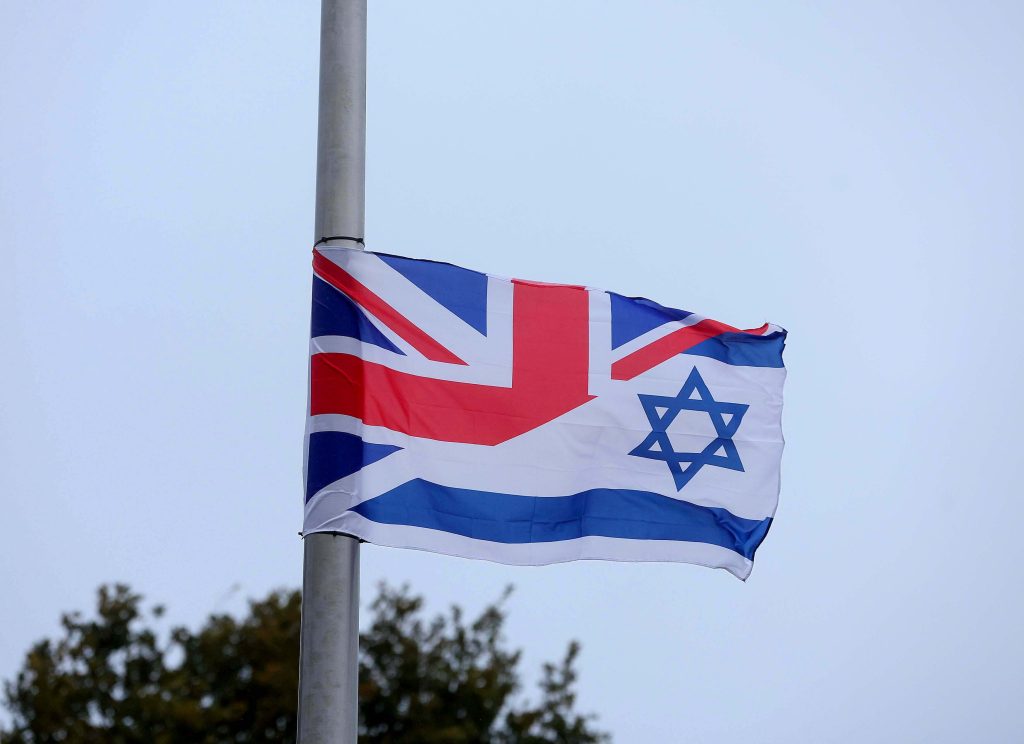
This article by W. Owl first appeared in Unity, the weekly publication of the Irish Communist Party. (photo credit: Mal McCann)
IRISH News columnist John Manley wrote a piece in the paper -27 Jan-under the heading “for God and Israel” which posed the question as to what lies behind unionism’s strong and enduring affiliation with Zionism? He quotes the author of a book on the subject, Dr Veronique Altglas, of Queens University who dismisses the claim that unionists support Israel simply because their traditional adversaries are pro-Palestine as reductionist, making the point that it is not tit-for-tat but more that among the hard-line unionists, support for Israel carries deep symbolic weight, not only in relation to the Israeli state itself, but in how it resonates locally.
For some Israel represents a besieged and misunderstood state mirroring their own identity. As Manley writes when you see Israeli flags on lampposts in east Belfast, the Star of David sitting alongside the union flag on twitter blogs, politicians going on fact-finding mission sponsored by a government accused of genocide, there is little doubting unionism’s strong and enduring affiliation with Israel.
He adds that as avowed republicans are in backing oppressed and persecuted peoples’ causes across the world unionisms support for the Zionist project is unwavering.
He also refers to what he describes as unfounded myths “rarely found these days”, about Ulster Protestants being “a lost tribe” but there are direct associations courtesy of Belfast-born Chaim Herzog, the first president of Israel, and the claim by Ronald Storrs, the military governor of Palestine-1917-1920, that the logic of the Balfour Declaration was to form “a little Jewish Ulster in a sea of potentially hostile Arabism.”
Manley makes the point that while occasionally unionists support for Israel can be seen as just a stunt designed to poke in the eye republicans, nationalists or anybody else sympathetic to the republican’s cause, there is something deeper in the relationship, a coupling bonded by both a sense of divine entitlement and fear.
In her book with a rather lengthy title: Judaizing Christianity and Christian Zionism in Northern Ireland: For God Israel and Ulster, Dr Altglas refers to the Christian Zionism idea that the modern state of Israel’s existence is the fulfilment of prophecy and a precursor to the second coming of Jesus which will take place in Israel, an idea apparently popular among the evangelists.
Manley quotes fellow Irish News columnist Alex Kane who believes that the affiliation stems from similarities between the fledging NI statelet founded in 1921 and the state of Israel which came into being a quarter of a century later, he stated, “I think when unionists looked around the world they saw parallels with Israel-a plucky little state, where like in Northern Ireland, they were creating and nurturing a new identity. Unionists see Israel and they think, that’s us- a place where you have to fight because there are people who don’t want you to exist.”
Manley also quoted Traditional Unionist Voice press officer Sammy Morrison who is also a deacon in the Dromore Free Presbyterian church who also sees parallels between unionist and Israelis in that their right to exist in respective homelands is questioned by others.
These sentiments are echoed by Dr Altglas when she writes that “There’s a sense that the unionist experience is similar to the Israelis, a sense that “we know what the Israelis are going through because we lived through it as well. We know what it is like to be unpopular and misunderstood by the international community.” She adds “It resonates and speaks so much to unionists because it’s a model that some would like to emulate, interwoven with Christianity.”
Unfortunately, the above opinions are based on simplistic notions, distortions and historical exclusions. The fact is that Jewish emigration into Palestine, even before the holocaust, was intent on ethnic cleansing the indigenous population no mention of the claim that Palestine was a “land without people for a people without a land.”. No mention of the role of the Irgun, the Stern Gang, or the Haganah” all defined as terrorist groups” in the establishment of the state. Certainly there are parallels with Ulster. No mention of the treatment of the catholic population by those who were “unpopular and misunderstood.”
The “siege mentality” wrote about is of their own making. Unionists had no intention to reach out to the catholic population and Israelis were quite content to be a “little Jewish Ulster” hostile to the Arab neighbours and the Palestinian in particular. Parallels indeed.
I find the comparison between the North and the Middle East in this article revealing. Ronald Storrs described the goal as creating “a little Jewish Ulster in a sea of potentially hostile Arabism” which shows that this “siege mentality” was often a deliberate political strategy rather than a divine plan.
While the article mentions “Christian Zionism,” it is important to remember this is a minority view. Most Christians globally believe the Gospel is about justice for everyone, not just one group. My faith is built on the command to “love our neighbours,” which means standing with those who are oppressed or living under occupation.
Mainstream Protestant churches in Ireland have been clear in their calls for peace and justice. The Methodist Church in Ireland has expressed “outrage” at the humanitarian situation in Gaza. They have called for a complete ceasefire and stated that the building of illegal settlements is a violation of international law that must be reversed. The Presbyterian Church in Ireland has also welcomed ceasefires as a source of hope, urging that “genuine and lasting peace” can only come by addressing the root causes of the conflict.
Our future in a united Ireland should be built on the principle of equality for all citizens. We should look to a tradition that seeks to lift up the vulnerable rather than one that uses religious ideas to justify a state of siege