
The following article by Mike Morrissey was first published in Unity, the weekly paper of the Irish Communist Party.
JUST after the first of this year’s heatwaves, Andrew Neil posted ‘All next week London temperatures won’t get above the late teens and it’s forecast to rain every day. It’s called the British summer. But at least we can expect some respite from the London-based media’s climate hysteria’ (Private Eye 21 August-10 September 2026).
Subsequently, there were four further heatwaves, drought declared in much of England and all of Wales, some water companies unable to supply their customers and an estimated £4 billion loss in economic output.
Elsewhere, the impact of climate change has been significantly more devastating. In Nepal as a result of warming, tens of millions of cubic metres of glacier ice fell over a kilometre into the valley below, simulating an earthquake and causing widespread destruction.
While such events are unlikely to either change his conviction or deflate his arrogance, Neil’s post is but one example of an increasing trend where columnists identify ‘net-zero hysteria’, rather than climate change, as the real problem facing Britain. Private Eye characterises this as ‘deny, denounce, delay ‘. It reports that, in 2018, 90% of media articles mentioning net-zero also mentioned climate change. By 2024, articles in which the two were associated fell to less than 50%. Additionally, the future costs of fossil fuel are deemed negligible while it’s frequently claimed that other countries are doing nothing anyway, so why should the UK bother?
Last year, the UK added 2.5 gigawatts (GW) of solar power compared to 510 GW globally with China contributing just over 50% (www.solardataatlas.com). Total global capacity in 2025 was 2383 GW for solar with wind standing at 1200 GW. Hardly nothing. Even so, the argument is that during the transfer to renewable energy there will still be a gas and oil requirement for several years – hence the need to identify and tap existing reserves.
These views are no longer confined to the media with Reform and the Conservatives competing to denounce net-zero. Badenoch, still under the illusion that her party can win the next general election by moving even further to the right, has banned those who believe in net-zero, like Grant Shapps, from standing as Conservatives. Her most recent appointment as shadow chancellor, Andrew Griffith, promises ‘lower taxes, Britain drilling again to bring energy costs down, slashing red tape and Labour’s Employment Rights Act’ (BBC News 31/08/2026). His previous government role in the Treasury was to help prepare the disastrous Truss budget that nearly crashed the economy – good choice.
Lies, Dammed Lies and Statistics
Unlike Donald Trump, most net-zero sceptics do not deny the reality of climate change. Rather, by the selective use of numbers, they claim that the UK does not require a ‘rigid’ 2050 net-zero target. First, they argue (correctly) that Britain’s annual contribution to greenhouse gases is just over 1% of the global total. Even using a per capita measure (4.2 tons per year), ranks it 69th in the world (Wikipedia). Strictly speaking, its greenhouse output should also include the contribution of imported goods, raising that number to just over 6 tons (a 45th rank). Accordingly, since its national output makes only a marginal contribution to climate change, attention should instead be paid to other things – like the cost of living which, it’s argued, could be ameliorated by maximising the production of local fossil fuels.
However, Britain was the first country to industrialise which means that its cumulative contribution to climate change is significantly greater than its current one. Since 1850, Britain has been the fifth biggest generator of greenhouse gases (the US is, by far, the biggest). And, as a member of the G7 and has a permanent seat on the UN Security Council, has a substantial international presence. If it signals that it is unconcerned about climate change, there will inevitably be a negative impact elsewhere.
It’s also true that the UK is in the middle of an ‘adaptation gap’, the difference between the climate for which building, housing and infrastructure were built and the climate we are now experiencing. This was seen recently when track expansion was responsible for the derailment of two trains and the widespread difficulty of sleeping in badly insulated housing during heatwaves. The problem here is that many of the proposed solutions are energy intensive, for example air conditioning or even desalination plants to feed the water-hungry south.
The most sensible solution is to roll these out by expanding renewal energy capacity particularly in the electricity grid. Mismatches between the generation of wind/solar power and the grid’s capacity to absorb are also relatively common. The present model of auctioning projects to private providers accentuates the problem since long-term, holistic planning is required which markets only infrequently deliver. This is but one example of how privatised models fail to deal with contemporary problems – hence the argument that the ‘foundational economy’ should be in public control and operated for the common good.
The Politics of the North Sea Basin
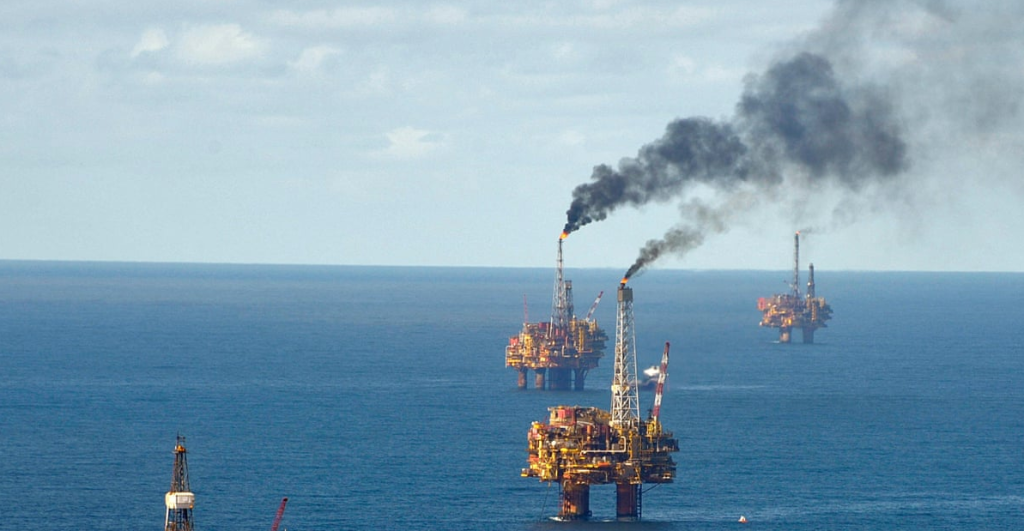
Even though its reserves have been seriously depleted, disputes about new drilling in the North Sea are now at the top of political discourse focussed on drilling licences for the Rosebank (actually in the North Atlantic) and Jackdaw oil and gas fields. The previous government granted licences but a Scottish court ruled them unlawful since the full environment impact was not considered. Given the energy crisis generated by Trump’s Iran adventure and relatively low gas stocks coming up to winter, it’s now argued that opening the fields would provide energy security and perhaps lower prices. Additionally, it’s claimed that gas from Jackdaw would have lower environmental impact than imported LPG.
The previous energy secretary, Ed Miliband, argued that extracting oil from Rosebank would be ‘climate vandalism’. Certainly, there would be no price-lowering impact since oil (refined outside the UK) and gas are both sold internationally and the environmental argument is dubious given that Norway is the principal source of imported gas. The argument for allowing gas extraction from Jackdaw is stronger given that it could supply around 6% of the UK’s future energy needs.
However, a new analysis from Imperial College London suggests that the cost of carbon pollution from the output of these two fields would range from £119 to £336 billion, considerably greater than the £27.8 billion of projected value from Adura, the Shell/Norwegian company planning to exploit them (The Guardian, 25/08/2026). This suggests intensifying effort around renewal technologies and, indeed, the net-zero sector has grown three times faster than the British economy as a whole in recent years – still no consolation for those who have lost jobs by the decline of the North Sea industry.
A Pragmatic Solution?
Britain’s new Prime Minister has promised a ‘pragmatic approach’ to new drilling provoking fury from most climate activists. Nevertheless, Michael Jacobs, previously a climate adviser to Gordon Brown, argues there is a pragmatic solution but that each field should be treated separately (The Guardian, 24/08/2026). Jackdaw is a small field with around 11 years potential output calculated to generate 24 million tons of carbon emissions. The gas would be piped directly to British consumers and would most likely, in this case, substitute for more polluting US LPG. Annually, it would contribute less than 1% to the UK’s annual emissions while helping secure energy supply. Since the Energy Secretary, Miatta Fahnbulleh, has to consider new information on emissions contribution, it should be possible to approve that licence. The Rosebank oil field, however, has a 25-year production span, would generate ten times the Jackdaw emissions and the oil would be refined in the Netherlands given the UK’s limited refining capacity. Jacobs argues ‘Giving consent to the Rosebank field on condition that it pays for its emissions to be captured and stored – say, from 2035 onwards – is the only way to make it compatible with the UK government’s domestic and international climate change commitments’. Cost considerations may prevent the company taking up the licence on these terms but that would simply demonstrate exploiting the field is incompatible with climate objectives.
Given, the daily news about the catastrophic impact of climate change globally, it appears sensible to simply ban all new drilling for fossil fuels. In an ideal world, the government would so while committing to dramatically intensify investment in renewal energy. However, the reality is that the UK will continue to consume oil and gas for several years yet. In this world of flawed politics and permanent economic crisis, perhaps nuanced decision-making is also desirable.