
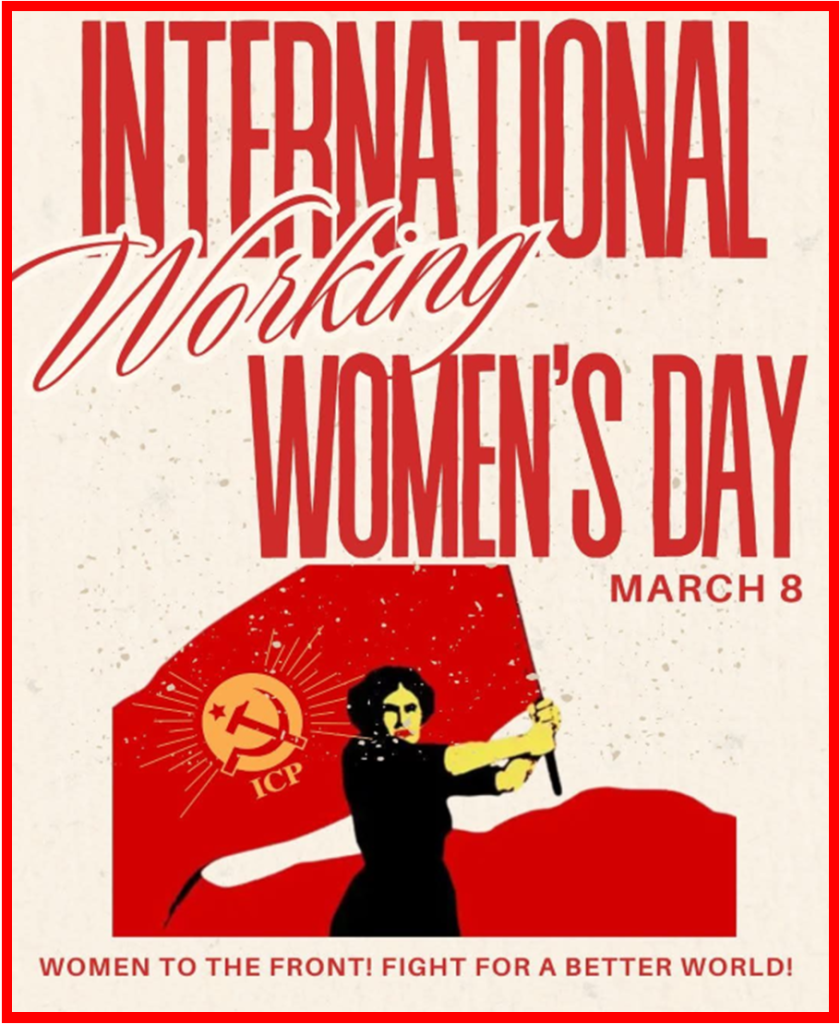
This article by Ciarraí Ó’Curnaín first appeared in Unity, the weekly publication of the Irish Communist Party.
Amidst the build up to another International Women’s Day it can grate hard on women activists to witness the occasion too often being commercialised and reduced to marketing gimmicks and superficial empowerment messaging. International Working Women’s Day was built by and is still championed by women who want to make substantive and systemic change to our society and world.
One of those women, Mary “Mother” Jones (1837-1930) was a life lived true to the concept of revolutionary praxis within the heart of industrial imperialism. From a Marxist-Leninist perspective, she was not simply a compassionate reformer but a committed class warrior whose methods and philosophy rang true to the tenets of disciplined, mass-based struggle against the capitalist state. Her legacy is one of unyielding confrontation, grassroots organisation, and a living testament to the Leninist axiom that the emancipation of the working class must be conquered by the workers themselves.
Mother Jones’s political education was forged in the kiln of early capitalist accumulation in the United States. Having endured personal tragedy—the loss of her family to yellow fever and her belongings in the Chicago Fire—she witnessed systemic violence inflicted upon workers by the mine, mill, and factory owners. This experience led her to the Marxist understanding of capitalism’s inherent brutality, where labour is commodified and workers are reduced to expendable factors of production. Jones recognised that appeals to bourgeois morality were futile; as she declared , “the bourgeoisie is not a party, it is a condition.” Her consciousness evolved from grief to a clear, unapologetic class position, aligning herself completely with the most exploited worker: miners, child labourers, and steelworkers. Her approach was one of a Leninist concept of building class consciousness not in the form of abstract dogma, but through agitational clarity. She translated the complex exploitation described in Das Capital into visceral, understandable terms for workers living it. Her famous motto, “Pray for the dead and fight like hell for the living,” was a call to move beyond passive suffering to organised action. Jones functioned as a one-woman vanguard cadre. She operated on the principle that the workers’ movement, left to its own devices, could develop only limited trade union consciousness. Her role was to elevate this into real and political class consciousness by linking immediate grievances to the broader system. She lived among the masses, shared their dangers, and used effective, confrontational tactics to expose the class enemy and galvanize resistance.
A definitive example was her leadership during the 1912-1913 Paint Creek-Cabin Creek strike in West Virginia. This was not a simple labour dispute but a miniature class war, illuminating the repressive apparatus of the capitalist state. The miners, seeking union recognition and basic living conditions, were met with the privately paid “Baldwin-Felts” detective agency guards, who terrorised communities with machine guns and armoured trains. Jones arrived to organise and bolster the strikers, leading to her arrest. She was subjected to a military tribunal, convicted of conspiracy to commit murder, and sentenced to twenty years—a clear demonstration of the state acting as, the armed wing of the capitalist class. Demonstrating the state then as now acting as, a committee for managing the common affairs of the whole bourgeoisie. Her eventual release under national pressure highlighted the capacity of mass mobilisation as a counter to state repression. This struggle underscored the necessity of confronting not only the capitalist owners but also their armed guardians.
Jones’s ideology is captured in her speeches, magazine articles, and her 1925 The Autobiography of Mother Jones. Her writing consistently emphasises direct action and the irreconcilability of class interests. In the International Socialist Review, she argued against relying on electoral politics alone: “I have never had a vote, and I have raised hell all over this country. You don’t need a vote to raise hell!”.
Jones understood political power comes from struggle among the masses not from bourgeois electoral concessions.
Jones famously organised the “Children’s Crusade” of 1903—a march of mill children from Philadelphia to President Theodore Roosevelt’s Oyster Bay home—to protest against child labour. She sought to expose how capitalism consumes each generation of workers for profit and emphasised the need for solidarity across gender and ethnic lines within the working class. She organised miners’ wives into fierce “mop and broom” brigades during strikes, a practice that built community resilience and broadened the breadth of the struggle.
The bourgeois narrative seeks to sanitise Mother Jones as a feisty humanitarian. As Marxist-Leninist’s we must reclaims her as a revolutionary organiser. Her legacy today is a toolkit for struggle: the necessity of militant, rank and file organisation; the use of strategic confrontation to expose state violence and capitalist contradictions; and the unwavering commitment to class, not compromise. She understood that reforms wrested from capital are victories of struggle, not gifts of enlightened capitalists. In an era of renewed monopoly capital, rampant inequality, and the criminalization of protest, Mother Jones’s spirit remains vital. She teaches that progress is won not through polite negotiation with oppressors, but through the disciplined, courageous, and relentless organisation of the working class on the industrial and political field.
Her life was one of unwavering hell-raising conviction.
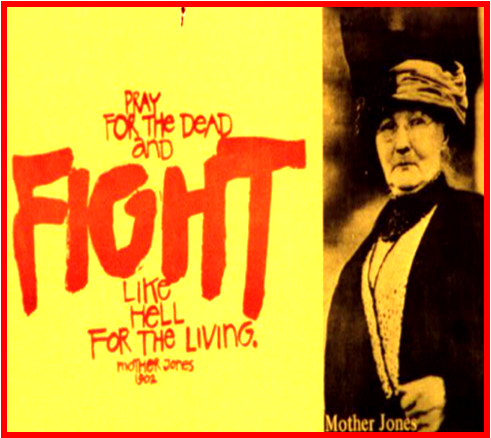
The Irish Connection:
Born Mary G Harris-Cork, Ireland-Baptised 1st August-
Died November 30th (aged93) Silver Spring, Maryland US
Resting place: Union Miners Cemetery Mount Olive Illinois
“WE know that Connolly accompanied Elizabeth Gurley Flynn, the young agitator of the IWW, when Flynn first heard Mother Jones at a radical meeting in the Bronx. Jones regaled them with tales of the Western capitalist extractive empires where she and other trades unionists had been placed in bullpens without habeas corpus rights.”
“JONES’ final comments to the world proclaimed that the globally organized labour class could organize the economy for the benefit of ordinary people, not the elite: “I am a red, a radical, an IWW, I’m anything that would change this moneyed civilization.” Through all the distinctions, she shared with Connolly and Larkin a deep belief that a worker’s republic was the only path to a “higher and grander civilization.”
“STILL, we should remember that for Jones, as for Connolly and Larkin in this era, socialism, radicalism, syndicalism all embodied a supremely democratic hope, a moral and fresh hope in possibilities and human potential.”
(Source Get off Your Knees”: Mother Jones, James Connolly and Jim )(Larkin in the fight for a Global Labour Movement—Rosemary Feurer.)
| MOTHER JONES FESTIVAL The Cork Mother Jones Committee announces that the 2026 Spirit of Mother Jones Festival will be held in and around the Shandon Historic Quarter over three days and nights from: Thursday 23rd July until Saturday 25th/2026 |
Fight on sisters —–& brothers!