

This article by Lynda Walker first appeared in Unity, the weekly publication of the Irish Communist Party.
THE right to have a roof over your head is a basic human right. The latest Northern Ireland Housing Bulletin produced quarterly by the Department of Communities said that during the period of April to September 2024, a total of 8,250 households presented as homeless. (The next bulletin is due in June)
The bulletin goes on to describe the top three reason why people present themselves a homeless, they were:
That the accommodation was not reasonable;
Sharing breakdown/family dispute;
And loss of rented accommodation.
These are the reason why they present themselves as homeless but they are not the reason why they do not have a home.
The simple answer to that is that social houses are not being built, the emphasis on a programme to build adequate public social houses at reasonable rents is not on the agenda.
High rents and profits come before people’s needs.
Asylum seekers and refugees face particular problems regarding accommodation. Recently according to the National Audit Office (NAO) some £400 million is the estimated cost for accommodation for asylum seekers.
According to the NAO, there were 2,741 people in asylum accommodation in Northern Ireland in December 2024. That included 413 people in hotels and 2,328 people in other accommodation. According to the NAO, asylum accommodation in Northern Ireland is among the most profitable in the UK, with a profit margin of 15% for the supplier.
The NAO says that in total three companies made a combined profit of £383m on asylum accommodation contracts between September 2019 and August 2024.
As it was discovered with COVID and the PPE scandal, there is no shortage of people looking to profit from other people’s misery. There is a solution the government continues to ignore.
Liz Griffith, from the Migration Justice Project at Law Centre NI, said that, while the cost of supporting asylum seekers is “expensive”, the cost is a “political choice”.
“It’s not good public policy to prevent people from working “If the government wants to save money, it should grant asylum seekers the right to work, as research shows that this would save the government £4.4bn.”
She said such a law change would mean that asylum seekers would also be able to make a contribution to the national Gross Domestic Product (GDP).
“Most importantly, it would restore dignity amongst those people currently waiting for a decision,” she added. When you have a skills shortage, preventing thousands of willing workers from actually working seems morally and economically wrong.”
Another issue relating to asylum seekers and homeless people are the conditions in which they live in the “hotels” and other places of accommodation. Where their rights are restricted and living conditions are inadequate. There are many reports about the problems that asylum seekers face regarding residing.
Empty Houses
It was reported in the Morning Star last week that in Scotland Greens are proposing that empty homes are used to tackle the housing crisis. the Greens are proposing to fill empty homes while Labour plan to build them as Scotland’s housing emergency enters its second year.
In a statement on Thursday, marking a year since the Scottish National Party government declared a nationwide emergency, Social Justice Secretary Shirley-Anne Somerville told MSPs they were investing £768 million to build 8,000 social and mid-market rent homes.
She said: “The latest programme for government reiterated our commitment to the delivery of the 110,000 afford able homes target by 2032.”
At a recent Belfast City Council committee meeting Councillor Micheal Collins made reference to Scotland when he said “It is worth looking at the Scottish model, which has had a lot of success in bringing empty homes back into public use.
Since 2010 there have been 10,899 homes in Scotland brought back into public use through this initiative – last year alone there were 1,875 empty homes brought into public use.
“It is right for us to put the onus on the Department for Communities to request funding from them. This will complement schemes we already have (in the council), including the Vacant to Vibrant scheme and the Housing Every Generation scheme.”
The use of empty homes may not be a long term solution but is it is one that has been proposed by groups who represent homeless people in Ireland, north and south.
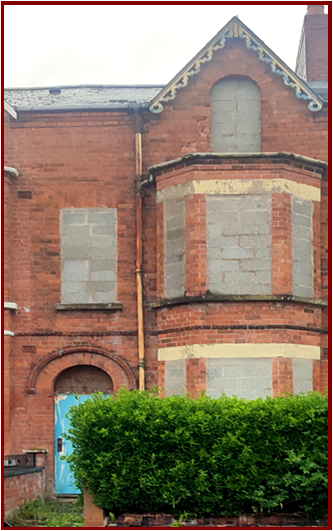
If you live on a street where one or more houses have been lying empty for years, don’t you wonder why the relevant bodies cannot requisition it and provide a home for one or more families.
It was announced in March 2025 that the Belfast City council was looking to look to appoint an ‘Empty Homes Officer’ to persuade owners of empty houses to turn them into homes again.
Following a motion put by Green Party Councillor Áine Grogan and Councillor Michael Collins, People before Profit, Belfast Councillors agreed at the March meeting of the Strategic Policy and Resources Committee to commission an officer report looking at the implications and costs of proposals
The motion called for funding from the Stormont Department for Communities to create a council role to deal with empty houses.
According to Land and Property this figure sits at 3,694 for the Belfast area.
There are 13,197 people on the housing waiting list in the city.
The motion stated: “As a local authority, the council commits to working with the relevant departments to try to bring empty homes back into use as affordable and social housing.
The council notes that the Department for Communities Empty Homes strategy, which aimed to do this, ended in 2018.
The council therefore commits to developing a strategy alongside DFC, the Housing Executive and other statutory bodies to ensure there is a coordinated action plan to bring disused homes into public use.
“This action plan will be funded, and appropriate measures such as an empty homes rates premium, strengthened compulsory purchase powers and financing support for converting empty homes into social housing will be brought forward to ensure it is to be delivered.
“The council will seek to establish an Empty Homes Partnership, similar to the Scottish model, which will coordinate these efforts with the relevant bodies. The council will also seek funding from DFC to appoint an Empty Homes Officer in order to liaise directly with the owners of empty homes, to understand why the home is empty, and to offer tailored solutions to turn it into a home again.”
A representative from Community Action Tenants Union, (CATU), told the full Belfast Council: “People are making profit from this housing crisis, and the Housing Executive are complicit in lining the pockets of private landlords and private companies providing temporary accommodation.
Recently a housing advisor said in a meeting with one of our members that their ‘hands were tied’ by private companies in relation to housing stock.“Social housing should not be a money making scheme. 34.4 million pounds was spent on temporary accommodation in 2023-24. We see the budget for social housing go into hostels, hotels, B&B’s as temporary accommodation. These accommodations have facilities that are unacceptable, and conditions that border on inhumane.” She said: “The housing crisis is the biggest crisis on this island today – it is connected to every other issue. It is connected to the race riots we saw last summer, to elderly people in our society feeling isolated. It is related to domestic violence, and workers feeling disempowered.”
New Social Housing?
A report this week in the Irish News (May 26) stated that funds earmarked for new social housing may be up to £100million less than originally pledged.
Put bluntly this would mean that the new build needed in the social sector to address deepening demand would be reduced to just half of that required
Communities Minister Gordon Lyons is expected to make a statement in the assembly on the 2025-26 housing budget in the coming days.
His department’s executive-endorsed the Housing Supply Strategy, which was published last autumn, set a goal of 100,000 new homes over the next 15 years, with one-third designated for social housing.
What needs to be challenged here is why only one-third of the new homes were designated for social housing.
Profiteering from sale of houses, ownership by private landlords and housing associations is a major issue that is diametrically opposed to social housing, in that greed not need is the driving force. This issue will never be solved until we get a strategy which accepts that social housing is a human right and not a privilege–that it is acknowledged and acted upon.