
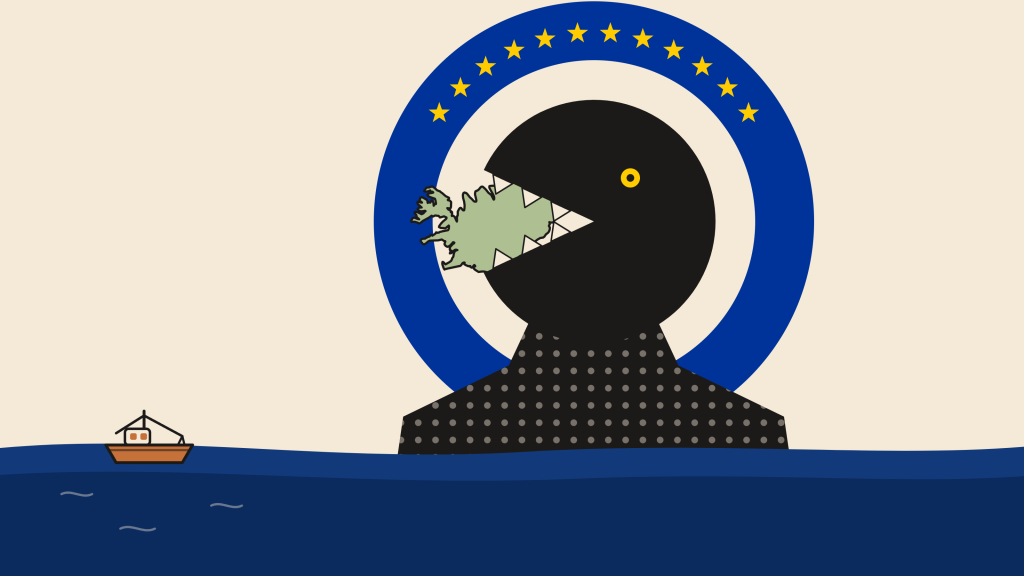
The following article by Eoin Ó Murchú was first published in Unity, the weekly paper of the Irish Communist Party.
ICELAND has voted 'no' to a government proposal to open talks with the European Union on the possible accession of the North Atlantic state. By a comfortable 52.5% to 47.5% margin the possibility of accession talks was rejected.
This is a major setback to the flailing European would-be super-state following the failure of accession referenda in Norway and Switzerland, along with Britain's departure from the union. The EU is now scrabbling among the fractious Balkan states and in a Ukraine that is a byword for corruption at its most extreme for new applicants.
Meanwhile, of course, as Germany, the industrial powerhouse of the union goes into recession, so does the rest of the EU with it.
The Icelandic government hoped that holding a referendum on whether or not to open talks would be a clever ploy. They thought that even opponents of membership would be interested to see what the EU would put on the table.
Instead, the Icelanders saw through the trick. They knew that opening talks, with a financial establishment solidly in favour of membership, would be to give a potentially unstoppable momentum behind the effort to rope Iceland in.
The government comprises the Social Democratic Alliance – a typical social democrat party that is happy to bargain away Iceland's sovereignty – the centre right Reform Party and the Welfare oriented People's Party. They attempted to use the uncertain international situation, and especially the vagueness of US President Trump's attitude to the island, which he has several times confused with Greenland, to sway voters, but to no avail.
The key issue was the question of fisheries. Iceland is a relatively rich country, but its wealth is totally dependent on its fisheries. It is estimated that fishermen voted 90% against talks with the EU, concerned that the predatory Common Fishing Policy, which has seen a majority share of the fish taken in Irish waters belong, under EU rules, to French and Spanish fleets. Would hand their fisheries over to Europe.
Iceland is also highly protective of its agricultural sector, though it is a member of the single Market and has access to the EU market for its produce, as well as free movement to the bloc.
It was suggested that the major concessions that the EU would have had to make in respect especially of the common Fishing Policy could have been exploited by Ireland to regain a larger share of our own fishing waters.
But that would have required a government willing to fight the EU, and with the opposition parties, including Sinn Féin lining up to support EU membership, it is fanciful to imagine that such a fight would be made by this government or by a Sinn Féin led one.
The issue, however, puts into sharp relief the cavalier way that the Irish state, back as far as 1972, was willing to give Ireland's fisheries away for nothing. What should have been a sector that could have provided economic stimulus to the Western seaboard has instead seen our fishing communities struggling to survive.
The EU, of course, hasn't given up the fight. It was worth noting the outrageous comments of RTÉ's Europe Correspondent – more accurately titled RTÉ's EU propaganda officer – Tony Connelly. He conceded that the EU had lost, but then added that the issue was now "settled at least until 2028".
Why 2028? Because the EU intends to try and force another debate and another referendum on the people of Iceland. The EU's motto is that if the people don't vote the "right" way they should be made to vote again and again until they get it "right".
This is what they did in Ireland, concerning the Lisbon and Nice Treaties, while, when the French and Dutch rejected the proposed EU Constitutions, they just ignored the whole process, repackaged the proposals as mild administrative changes and brought them in without any vote at all.
And, as we know, in Moldova and Romania the EU fixed the vote. Moldova is a simple example. A majority of Moldovans living in the country voted against the EU, but their votes were swamped by EU organised votes in the EU states, while voters in Russia and in the separate republic of Transnistria were denied any vote at all.
So, be warned. The EU is down, but not out.