
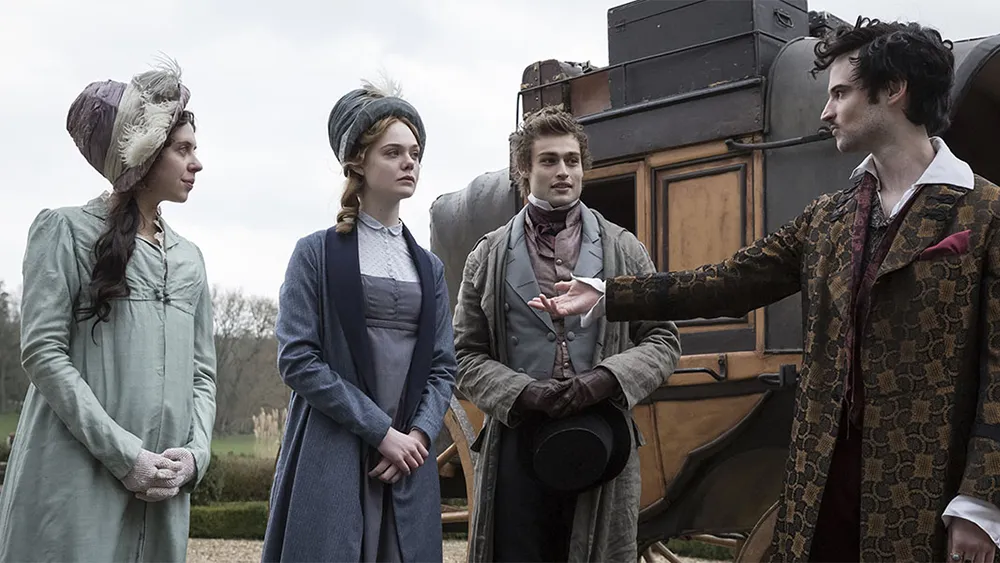
This article by Dr Jenny Farrell first appeared in Unity, the weekly publication of the Irish Communist Party.
MARY Wollstonecraft, advocate of women’s rights, she grew up immersed in debates about reason, social reform, and equality. Frankenstein engages with contemporary materialist science, presenting life as a product of matter rather than divine intervention. Political and social pressures extended to her family: Percy Bysshe Shelley’s atheism and radicalism made England hostile, prompting the couple’s 1816 exile to the Continent.
The novel was conceived that summer at Lake Geneva, in a circle including the Shelleys, Byron, and Byron’s doctor Polidori. The “Year Without a Summer” forced indoor evenings of philosophical and scientific discussion. A ghost story challenge issued by Byron inspired Mary Shelley’s Frankenstein and Polidori’s The Vampyre, the latter establishing the literary archetype of the aristocratic vampire. Mary Shelley, however, transformed the prompt into a novel examining science, responsibility, and social exclusion.
Frankenstein narrates Victor Frankenstein’s attempt to animate life from assembled body parts. Rejecting his creation, Victor abandons it. The Being initially behaves kindly, learning language, literature, and social conduct. Repeated rejection and cruelty drive it towards revenge.
Settings in the novel carry political significance. Geneva, Victor’s home, represents Enlightenment contradictions: repressive Calvinism versus Rousseau’s radical philosophy. Ingolstadt, where Victor establishes his laboratory, was associated in British imagination with the Illuminati, a feared Jacobin-atheist ‘conspiracy’. Victor’s experiments mirror revolutionary transgression, but his failure lies not in ambition, but in irresponsibility and moral abdication.
Shelley contrasts Victor with the Being. Victor is reckless and emotionally immature; the Being is reflective, ethical, and attentive. Learning through observation, experience, and literature (Plutarch, Goethe, Milton), the Being demonstrates that moral competence requires sustained reflection and social awareness. Its innate benevolence is corrupted only by Victor’s neglect and society’s rejection.
The creature’s request for a female companion represents a claim to natural justice, and Victor’s destruction of it completes its isolation. After Elizabeth’s murder, Victor becomes the obsessed hunter, mirroring the Being’s earlier quest, culminating in an Arctic chase that symbolises moral and political exile.
Shelley grants the Being the final word, highlighting the novel’s central insight: neglect and abdication of responsibility, rather than the creature, create monstrosity.
The subtitle, The Modern Prometheus, underscores the political and ethical dimensions. Shelley frames the novel with Milton’s Paradise Lost, emphasising that authority without responsibility breeds violence. Scientific creation is thus inseparable from social and moral accountability.
The novel also engages with expansionist and imperial ambitions. Clerval’s ideas about improving India and Walton’s Arctic expedition evoke empire and mastery over nature. Victor embodies the dangers of unchecked ambition.
The Being, disciplined and reflective, demonstrates that sustained moral development can flourish only when nurtured by recognition and care. Its trajectory prefigures Heathcliff in Wuthering Heights, exposing social hypocrisy and prejudice.
Both Mary Shelley and Emily Brontë challenge bourgeois norms, demanding a radical reconsideration of social and ethical responsibility.
Ultimately, Frankenstein is a political and philosophical meditation on science, morality, and society. In a climate of repression, it critiques illegitimate authority, emphasises moral growth through experience, and shows that neglect and irresponsibility, rather than innate nature, produce destruction.
Knowledge and power divorced from ethics yield ruin, while attentiveness, reflection, and compassion offer the path to human flourishing.
Dr Farrell shows that Frankenstein is a warning about the duty of care we owe each other. As a Christian, I see Victor’s failure as a rejection of stewardship. He creates life but refuses the responsibility to love and guide it.
The Being’s descent reminds us that people are shaped by how they are treated. In my faith tradition, we are called to care for the vulnerable. When a system neglects the poor, it is a moral failure.
I deeply respect that Shelley wrote from an atheist perspective. Her focus on human accountability challenges us as believers to not wait for divine intervention to fix the world. It reminds us that we must take full responsibility for the systems we build.
As a Progressive Christian, I believe we must challenge power that lacks accountability. We need a society built on the compassion and justice that both our faith and Shelley’s radical humanism demand