
This article by Jenny Farrell first appeared in Unity, the weekly publication of the Irish Communist Party.
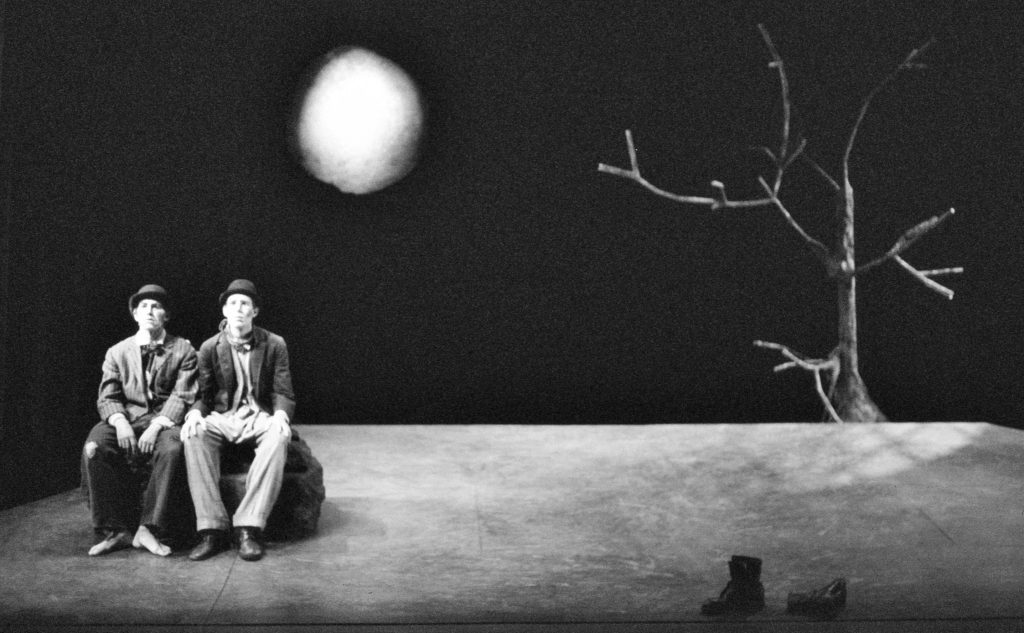
Samuel Beckett’s Waiting for Godot (1948) confronts a world shaped by war, destruction, and the fear of total annihilation. Echoing Bertolt Brecht’s warning that civilisations can vanish without trace, the play imagines what remains after catastrophe. Its stark setting — “a country road, a tree, evening” — reduces existence to a minimum, asking what will be left of humanity after another war.
Born in 1906, Beckett moved to Paris in 1928, where James Joyce introduced him to avant-garde circles. During World War II, Beckett joined the French Resistance, living under constant threat. This experience deeply shaped his work. After the war, he began writing in French to achieve a sparse, controlled style, producing his most important works, including Waiting for Godot, which premiered in 1953 and established his international reputation. He later received the Nobel Prize in Literature.
The play reflects the anxieties of the nuclear age, especially after the Atomic bombings of Hiroshima and Nagasaki. Though never stated outright, its empty landscape suggests a post-apocalyptic world. Vladimir (Didi) and Estragon (Gogo) barely survive, struggling with simple actions and enduring routine violence. Humanity has been reduced to basic survival.
From its opening line, “Nothing to be done,” the play establishes a condition of paralysis. There is no real action, only endless waiting for the absent Godot. Waiting replaces purpose and becomes a metaphor for existence itself. The Irish allusion to “go deo” (forever) hints at endless duration, reinforcing the sense of purposelessness.
Beckett dismantles traditional drama. Without action, there is no plot, no development, no resolution. The audience shares the characters’ experience of empty time, forced to confront meaninglessness directly. The play does not merely depict absurdity — it creates a new form built from it.
Religious and philosophical certainties have eroded. Biblical references are vague and fragmented. Estragon’s fleeting claim to be “Adam” suggests humanity reduced to its most primitive state, echoing King Lear’s image of the human as a “poor, bare, forked animal.” Civilisation’s intellectual and moral structures have collapsed.
This decline is reflected in Pozzo and Lucky. Pozzo, a master figure, controls Lucky, his enslaved servant, evoking colonial power dynamics and recalling Caliban. Yet, this hierarchy deteriorates: in Act II, Pozzo is blind and Lucky mute. Authority and thought themselves break down.
Lucky’s chaotic monologue encapsulates the play’s core. Mixing philosophical language with nonsense, it suggests a distant or indifferent God and a humanity that “wastes and pines.” The idea of “unfinished labours” points to both divine abandonment and human failure. Its absurd mixture of the profound and trivial shows how cosmic collapse and everyday banality coexist.
Despite its bleakness, the play contains faint traces of humanity. Didi and Gogo depend on one another, forming a fragile bond. When they consider suicide, they hesitate partly out of concern for each other, suggesting that connection still has value.
A key moment occurs when Pozzo cries for help. Didi recognises that such moments are rare and that their response represents all humanity: “at this place… all mankind is us.” This briefly restores a sense of shared responsibility. Yet the insight is undercut as all four characters remain helpless, unable to act.
Pozzo’s reflection that humans are born “astride of a grave” reinforces the play’s bleak vision of life on the brink of annihilation. And yet, Beckett avoids complete nihilism. The tree sprouts a few leaves by the end, hinting at survival. The companionship between Didi and Gogo, however fragile, suggests that compassion survives.
Ultimately, Waiting for Godot leaves its audience with an unresolved question: are these small remnants of humanity enough? Beckett offers no answer, forcing us, like his characters, to endure uncertainty and consider whether we can move beyond waiting.