
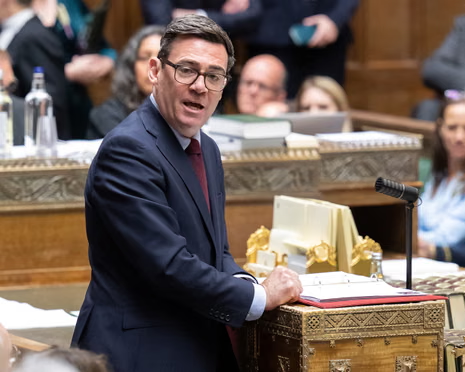
The following article by W. Owl was first published in Unity, the weekly paper of the Irish Communist Party.
ANDY Burnham certainly ruffled some feathers when he said that a border poll is "off the table." However, it was left up to Secretary of State Chris Bryant to clarify the position when he said that it did not mean that it was permanently off the agenda. Newton Emerson writing in the Irish Times quoted the First Minister Michelle O'Neill who said that Burnham's comments were "arrogant" and insisted that the Belfast Agreement provided "a right" to a border poll.
Malachy O'Doherty in his piece in the Belfast Telegraph 1.9.26 disagreed when he wrote that the prospect of an early border poll does not rely on the Belfast Agreement as it only sets out the conditions under which a poll must be called. He did suggest that if these conditions were met and the Secretary of State did not call one, then that failure would be challenged in the courts and reversed.
However, since those conditions do not exist, he believed the tub-thumping for a referendum seems pointless. He adds to this yet Sinn Fein, Fine Gael and Leo Varadkar and even the SDLP talk up the prospect of a united Ireland as if the rest of us are all missing something and "maybe we are". He then goes on to write that clearly Sinn Fein is trying to make the argument that the agreement required a border poll imminently but as far as he in concerned this is an "illiterate" reading of the agreement.
He states that he does not understand why they should keep insisting that the agreement says something that it doesn't, but they do, whether through ignorance or mischief making.
He does then point out that there is another route to the border poll aside from the agreement as it does not say that the British Government may only call a referendum in circumstances in which it is likely to be carried. He cites the situation in 1973, when a referendum on Irish unity was held in Northern Ireland.
At that time the Irish Government, in talks with the then British Prime Minister, Edward Heath, insisted that the whole Catholic or "minority "community in Northern Ireland wanted and end to partition. O'Doherty states that Heath had to undercut that claim and that's why a vote was held. However, many Nationalists, perhaps alert to that intention., boycotted it. He adds that when Fine Gael calls for research into how Ireland might be united, it has some thoughts in mind that it is not sharing.
One of those thoughts might be that a future prime minister might call for a border poll without reference to the agreement. In this he writes in stating "off the table" Burnham is speaking for a tenuous placed government which might not win the next election in 2029. This is when O'Doherty refers to the elephant in the room, or the villain of the peace if you prefer, Nigel Farage. This leads him to ask the question, what if he becomes the next prime minister? Whilst he believes Farage's position is somewhat weakened because of the scandal around the massive donations he has accepted and is further exacerbated by his apparent withdrawal from public view.
A few weeks ago this seemed a realistic prospect. He makes the point that fortunately his Reform Party is in a large part a personality cult built around him and his cheeky chappy ways but disgrace or shame stripping him of his prospects would almost certainly deflate the whole party around him.
He wants to end the British commitment to the European Convention on Human Rights on which the Belfast Agreement depends and so he may think it would be simpler to dump Northern Ireland than to cope with the legal complexities that it presents for his project.
He does suggest that a Farage government might indeed tilt thinking in Northern Ireland away from the union but in his opinion it hasn't.
He concluded that Burnham might not be head of the table in three years that is why there must be a discussion about how a transition to a united Ireland can be managed
The conditions required by the Belfast Agreement for a poll have not been met, but they don't need to be.