
The following article by Eoin Ó Murchú was first published in Unity, the weekly paper of the Irish Communist Party.
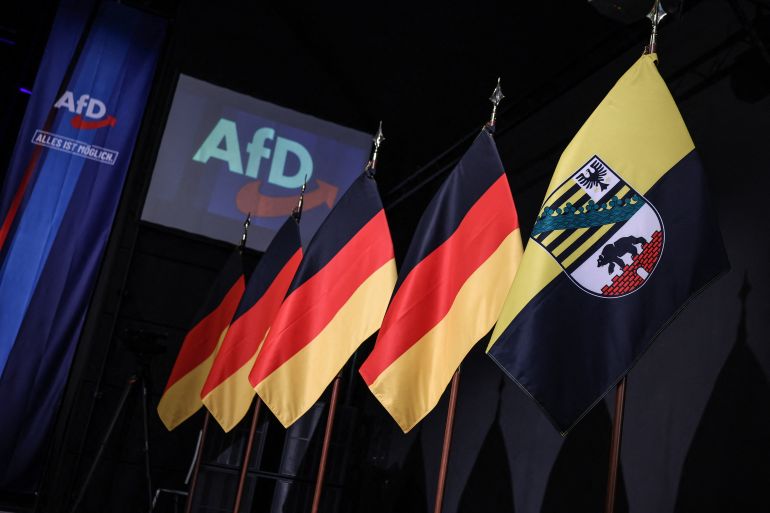
THE victory of the AfD in state elections in Saxony Anhalt eastern Germany has sent shock waves through the entire German establishment. And it was the scale of the win more than the win itself that added to the shock.
The AfD scored nearly 44% of the vote, while the previously ruling CDU – the party of German chancellor Friedrich Merz – saw its vote more than halved to a paltry 17%.
This result gives the AfD 39 seats in the local parliament of 83, just short of an overall majority, but in an unassailable position when it comes to forming the next state government.
Even more significant is that the BSW, the far-left party led by the charismatic Sara Wagenknecht, also entered the state parliament winning five seats. It is in a position to decide the balance of power.
While the BSW has fundamental differences with the AfD on economic policy, it agrees with the AfD on ending support for Ukraine and for restoring good relations with Russia, and is sympathetic to the need to control immigration. It has said it won't join a coalition with the AfD but will support it on a case by case basis.
The BSW split from Die Linke, the successor party to the old Socialist Unity Party of the GDR, accusing Die Linke of sidelining the working class and instead emphasising identity politics.
The AfD has been accused of being a proto-fascist party. It is, however, not a classic fascist party, but it does have the potential to be one. Its anti-immigrant rhetoric is vitriolic, and it certainly appeals to the undercurrents of racist and Nazi opinion in Germany.
But it is not the voice of big business. It represents the despair of the so-called Mittelstand, the small business network that thrived on the supply chains to the big manufacturing enterprises.
But, as these have gone into decline – with Volkswagen, for example, laying off hundreds of thousands of workers – so the Mittelstand has been crushed.
Economically, the AfD wants to restore Germany as a strong industrial power, rejecting subservience to the US and to Atlanticism as embodied in the EU. It looks to do this by restoring good relations with Russia and, once again, using cheap Russian energy to power its industrial rebirth.
But there are other factors involved in the AfD success which are central to its achievement. Above all, in the former GDR, there is intense resentment at how German reunification was done. In Saxony Anhalt, for example, which was the industrial heartland of the GDR, its whole industrial base was smashed by the takeover, the factories were closed, and Ossis reduced to poverty or to emigration to the West. It's worth noting that in these state elections the party's symbol was the old GDR moped, the Simson. More to the point, at at least one of the party's rallies the organisers played the old GDR national anthem, which the crowd joined in to sing enthusiastically.
Note too that 61% of the working class voted for the AfD, with GDR nostalgia and a benign outlook on Russia key factors in the East.
These factors do not apply in the West, of course. But the failure of the Establishment parties to halt Germany's economic decline – a decline quite clearly exacerbated by cutting its ties with Russia – is making the AfD more attractive there as well.
With the BSW pushing the AfD to curb its right-wing stress and to emphasise state-led industrial development, the firewall by which the establishment parties refused to deal with the AfD (or indeed with Die Linke or the BSW as successors to German communism) clearly has to go.
The CDU will abandon the firewall and do its own deal with the AfD, but can it bring itself to accept the rejection of Atlanticism and work to rebuild good relations with Russia? German politics has certainly been altered beyond recognition by the AfD triumph in Saxony Anhalt.